 Add to Chrome
 Add to Firefox
 Add to Edge
Harness-Bench: Measuring Harness Effects across Models in Realistic Agent Workflows
May 27, 2026
LLM agents are increasingly deployed as executable systems that use tools, modify workspaces, and produce concrete artifacts. In such workflows, performance depends not only on the base model, but also on the harness: the system layer that manages context, tools, state, constraints, permissions, tracing, and recovery. However, existing benchmarks typically abstract away execution, compare complete agent systems, or hold the harness fixed, making execution-layer variation difficult to study. We introduce Harness-Bench, a diagnostic benchmark for evaluating configuration-level harness effects in realistic agent workflows. Harness-Bench evaluates representative harness configurations across multiple model backends under shared task environments, budgets, and evaluation protocols, while preserving each harness's native execution behavior. The benchmark contains 106 sandboxed offline tasks constructed from practical agent-use patterns and manually reviewed for realism, solvability, oracle-checkability, and integrity. Each run records final artifacts, execution traces, usage statistics, and validator outputs, enabling analysis beyond final completion. Across 5,194 execution trajectories, we observe substantial variation in completion, process quality, efficiency, and failure behavior across model-harness pairings. These results suggest that agent capability should be reported at the model-harness configuration level rather than attributed to the base model alone. Our analysis further identifies recurring execution-alignment failures, where plausible reasoning becomes decoupled from tool feedback, workspace state, evidence, or verifiable output contracts. Harness-Bench provides a reproducible foundation for diagnosing and improving reliable, efficient, and auditable agent execution stacks.

Trait-Aware Policy Optimization for Autoregressive Multi-Trait Essay Scoring
May 26, 2026Multi-trait essay scoring aims to provide fine-grained evaluation of writing quality across multiple dimensions. However, how to effectively post-train autoregressive scoring models remains underexplored. In this paper, we propose Trait-Aware Policy Optimization (TAPO), a post-training framework tailored to autoregressive multi-trait scoring. Our method decomposes rewards along both the sample and trait dimensions, combining global scoring consistency, trait-level accuracy, format validity, and inter-trait dependency preservation. In addition, we use enhanced prompts throughout training by incorporating original prompt texts and trait descriptions, providing richer semantic information for trait-specific score generation. Experiments across multiple backbone models show that our method consistently improves multi-trait scoring performance over supervised fine-tuning and scalar-reward optimization baselines, demonstrating the effectiveness and transferability of trait-aware post-training for essay scoring.
Muon$^2$: Boosting Muon via Adaptive Second-Moment Preconditioning
Apr 11, 2026Muon has emerged as a promising optimizer for large-scale foundation model pre-training by exploiting the matrix structure of neural network updates through iterative orthogonalization. However, its practical efficiency is limited by the need for multiple Newton--Schulz (NS) iterations per optimization step, which introduces non-trivial computation and communication overhead. We propose Muon$^2$, an extension of Muon that applies Adam-style adaptive second-moment preconditioning before orthogonalization. Our key insight is that the core challenge of polar approximation in Muon lies in the ill-conditioned momentum matrix, of which the spectrum is substantially improved by Muon$^2$, leading to faster convergence toward a practically sufficient orthogonalization. We further characterize the practical orthogonalization quality via directional alignment, under which Muon$^2$ demonstrates dramatic improvement over Muon at each polar step. Across GPT and LLaMA pre-training experiments from 60M to 1.3B parameters, Muon$^2$ consistently outperforms Muon and recent Muon variants while reducing NS iterations by 40\%. We further introduce Muon$^2$-F, a memory-efficient factorized variant that preserves most of the gains of Muon$^2$ with negligible memory overhead.
Muon+: Towards Better Muon via One Additional Normalization Step
Feb 26, 2026The Muon optimizer has demonstrated promising performance in pre-training large language models through gradient (or momentum) orthogonalization. In this work, we propose a simple yet effective enhancement to Muon, namely Muon+, which introduces an additional normalization step after orthogonalization. We demonstrate the effectiveness of Muon+ through extensive pre-training experiments across a wide range of model scales and architectures. Our evaluation includes GPT-style models ranging from 130M to 774M parameters and LLaMA-style models ranging from 60M to 1B parameters. We comprehensively evaluate the effectiveness of Muon+ in the compute-optimal training regime and further extend the token-to-parameter (T2P) ratio to an industrial level of $\approx 200$. Experimental results show that Muon+ provides a consistent boost on training and validation perplexity over Muon. We provide our code here: https://github.com/K1seki221/MuonPlus.
Beyond Parameter Arithmetic: Sparse Complementary Fusion for Distribution-Aware Model Merging
Feb 12, 2026Model merging has emerged as a promising paradigm for composing the capabilities of large language models by directly operating in weight space, enabling the integration of specialized models without costly retraining. However, existing merging methods largely rely on parameter-space heuristics, which often introduce severe interference, leading to degraded generalization and unstable generation behaviors such as repetition and incoherent outputs. In this work, we propose Sparse Complementary Fusion with reverse KL (SCF-RKL), a novel model merging framework that explicitly controls functional interference through sparse, distribution-aware updates. Instead of assuming linear additivity in parameter space, SCF-RKL measures the functional divergence between models using reverse Kullback-Leibler divergence and selectively incorporates complementary parameters. This mode-seeking, sparsity-inducing design effectively preserves stable representations while integrating new capabilities. We evaluate SCF-RKL across a wide range of model scales and architectures, covering both reasoning-focused and instruction-tuned models. Extensive experiments on 24 benchmarks spanning advanced reasoning, general reasoning and knowledge, instruction following, and safety demonstrate, vision classification that SCF-RKL consistently outperforms existing model merging methods while maintaining strong generalization and generation stability.
HeaPA: Difficulty-Aware Heap Sampling and On-Policy Query Augmentation for LLM Reinforcement Learning
Jan 30, 2026RLVR is now a standard way to train LLMs on reasoning tasks with verifiable outcomes, but when rollout generation dominates the cost, efficiency depends heavily on which prompts you sample and when. In practice, prompt pools are often static or only loosely tied to the model's learning progress, so uniform sampling can't keep up with the shifting capability frontier and ends up wasting rollouts on prompts that are already solved or still out of reach. Existing approaches improve efficiency through filtering, curricula, adaptive rollout allocation, or teacher guidance, but they typically assume a fixed pool-which makes it hard to support stable on-policy pool growth-or they add extra teacher cost and latency. We introduce HeaPA (Heap Sampling and On-Policy Query Augmentation), which maintains a bounded, evolving pool, tracks the frontier using heap-based boundary sampling, expands the pool via on-policy augmentation with lightweight asynchronous validation, and stabilizes correlated queries through topology-aware re-estimation of pool statistics and controlled reinsertion. Across two training corpora, two training recipes, and seven benchmarks, HeaPA consistently improves accuracy and reaches target performance with fewer computations while keeping wall-clock time comparable. Our analyses suggest these gains come from frontier-focused sampling and on-policy pool growth, with the benefits becoming larger as model scale increases. Our code is available at https://github.com/horizon-rl/HeaPA.
TEON: Tensorized Orthonormalization Beyond Layer-Wise Muon for Large Language Model Pre-Training
Jan 30, 2026The Muon optimizer has demonstrated strong empirical performance in pre-training large language models by performing matrix-level gradient (or momentum) orthogonalization in each layer independently. In this work, we propose TEON, a principled generalization of Muon that extends orthogonalization beyond individual layers by modeling the gradients of a neural network as a structured higher-order tensor. We present TEON's improved convergence guarantee over layer-wise Muon, and further develop a practical instantiation of TEON based on the theoretical analysis with corresponding ablation. We evaluate our approach on two widely adopted architectures: GPT-style models, ranging from 130M to 774M parameters, and LLaMA-style models, ranging from 60M to 1B parameters. Experimental results show that TEON consistently improves training and validation perplexity across model scales and exhibits strong robustness under various approximate SVD schemes.
Sketch-Based Facade Renovation With Generative AI: A Streamlined Framework for Bypassing As-Built Modelling in Industrial Adaptive Reuse
Jan 13, 2026Facade renovation offers a more sustainable alternative to full demolition, yet producing design proposals that preserve existing structures while expressing new intent remains challenging. Current workflows typically require detailed as-built modelling before design, which is time-consuming, labour-intensive, and often involves repeated revisions. To solve this issue, we propose a three-stage framework combining generative artificial intelligence (AI) and vision-language models (VLM) that directly processes rough structural sketch and textual descriptions to produce consistent renovation proposals. First, the input sketch is used by a fine-tuned VLM model to predict bounding boxes specifying where modifications are needed and which components should be added. Next, a stable diffusion model generates detailed sketches of new elements, which are merged with the original outline through a generative inpainting pipeline. Finally, ControlNet is employed to refine the result into a photorealistic image. Experiments on datasets and real industrial buildings indicate that the proposed framework can generate renovation proposals that preserve the original structure while improving facade detail quality. This approach effectively bypasses the need for detailed as-built modelling, enabling architects to rapidly explore design alternatives, iterate on early-stage concepts, and communicate renovation intentions with greater clarity.
BOOST: BOttleneck-Optimized Scalable Training Framework for Low-Rank Large Language Models
Dec 13, 2025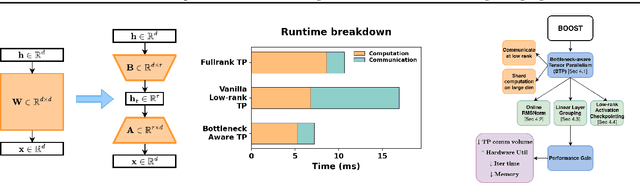
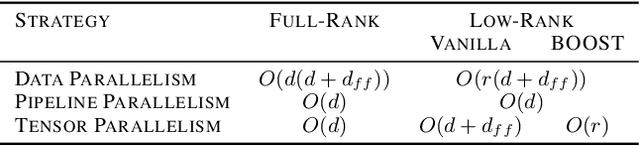
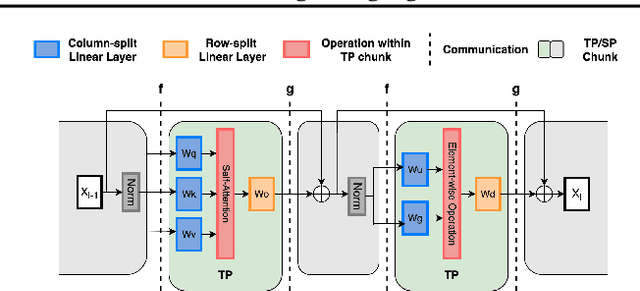
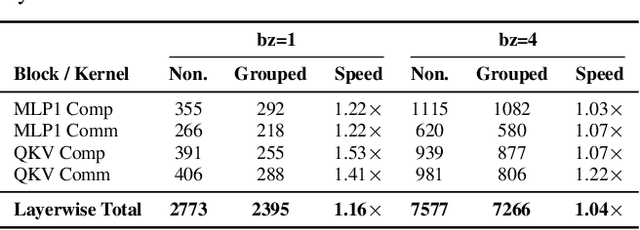
The scale of transformer model pre-training is constrained by the increasing computation and communication cost. Low-rank bottleneck architectures offer a promising solution to significantly reduce the training time and memory footprint with minimum impact on accuracy. Despite algorithmic efficiency, bottleneck architectures scale poorly under standard tensor parallelism. Simply applying 3D parallelism designed for full-rank methods leads to excessive communication and poor GPU utilization. To address this limitation, we propose BOOST, an efficient training framework tailored for large-scale low-rank bottleneck architectures. BOOST introduces a novel Bottleneck-aware Tensor Parallelism, and combines optimizations such as online-RMSNorm, linear layer grouping, and low-rank activation checkpointing to achieve end-to-end training speedup. Evaluations on different low-rank bottleneck architectures demonstrate that BOOST achieves 1.46-1.91$\times$ speedup over full-rank model baselines and 1.87-2.27$\times$ speedup over low-rank model with naively integrated 3D parallelism, with improved GPU utilization and reduced communication overhead.
SkipKV: Selective Skipping of KV Generation and Storage for Efficient Inference with Large Reasoning Models
Dec 08, 2025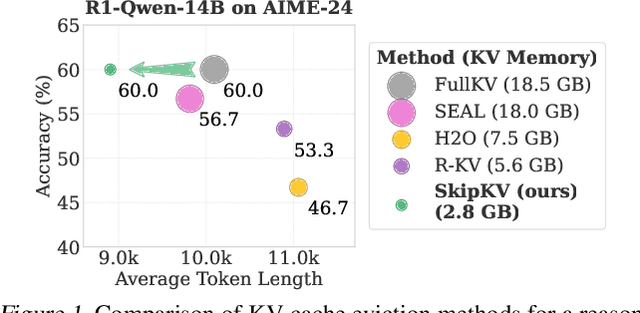
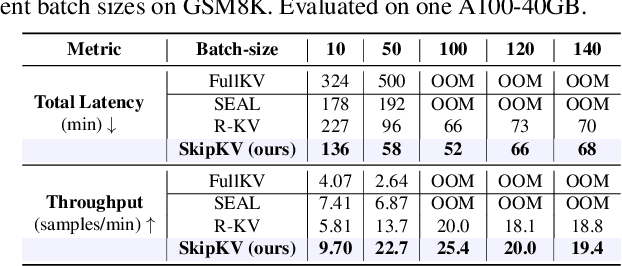
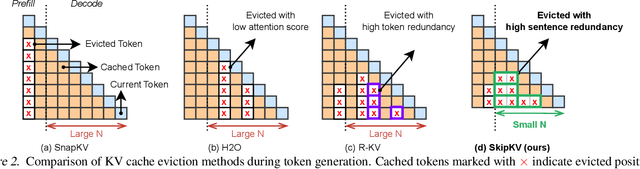
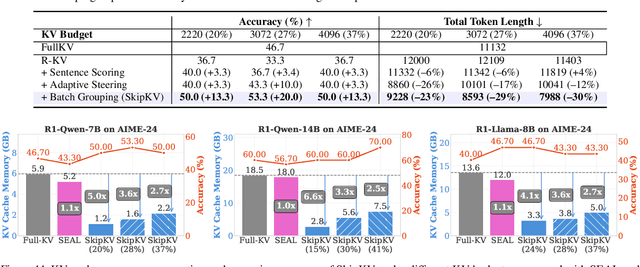
Large reasoning models (LRMs) often cost significant key-value (KV) cache overhead, due to their linear growth with the verbose chain-of-thought (CoT) reasoning process. This costs both memory and throughput bottleneck limiting their efficient deployment. Towards reducing KV cache size during inference, we first investigate the effectiveness of existing KV cache eviction methods for CoT reasoning. Interestingly, we find that due to unstable token-wise scoring and the reduced effective KV budget caused by padding tokens, state-of-the-art (SoTA) eviction methods fail to maintain accuracy in the multi-batch setting. Additionally, these methods often generate longer sequences than the original model, as semantic-unaware token-wise eviction leads to repeated revalidation during reasoning. To address these issues, we present \textbf{SkipKV}, a \textbf{\textit{training-free}} KV compression method for selective \textit{eviction} and \textit{generation} operating at a coarse-grained sentence-level sequence removal for efficient CoT reasoning. In specific, it introduces a \textit{sentence-scoring metric} to identify and remove highly similar sentences while maintaining semantic coherence. To suppress redundant generation, SkipKV dynamically adjusts a steering vector to update the hidden activation states during inference enforcing the LRM to generate concise response. Extensive evaluations on multiple reasoning benchmarks demonstrate the effectiveness of SkipKV in maintaining up to $\mathbf{26.7}\%$ improved accuracy compared to the alternatives, at a similar compression budget. Additionally, compared to SoTA, SkipKV yields up to $\mathbf{1.6}\times$ fewer generation length while improving throughput up to $\mathbf{1.7}\times$.